Showing posts with label creating buzz. Show all posts

Monday, June 27, 2011

Independent Music Promotion on the Web: 3 Steps to Success

Let's face it, the wildfire spread of web-based portals designed to introduce independent music to the world has created a bewildering array of opportunities and costs. So where do they all balance out? When does the cost of signing up to yet another music promotion service yield results? What results are we looking for anyway?


The key is to make your web promotion targeted, systematic and rich.

What is the main drive for independent artists promote their music on the web? The fundamental incentive for web promotion is the opportunity to get your music heard by people who might otherwise never know that you exist! If people know you exist they can become fans and repeat-listeners. Which of those fans buy CD's and downloads? Targeted listeners.

The most important goal of web promotion is to attract targeted listeners.

Any independent artist who says they use the web to sell their music has missed the primary target - attracting targeted listeners. Attracting targeted listeners should be every independent artist's first priority. Remember, you don't sell your music - listeners BUY your music. It's a buyers market. The more targeted listeners you have, the more sales you make - provided you are systematic in getting your targeted listeners.

The best way to get targeted listeners is to be systematic.

Many artists tend to approach their web promotion thinking that since they have a website and have signed up to a couple of artist showcase sites, that the listeners will just come pouring in. Yes you have managed to target some potential listeners, but you still have to shout, "Hey, over here...you'll like the sound of this!" A systematic approach to getting listeners to hear your music will attract and maintain their interest. But remember to make sure you have the content ready for the listener to enjoy.


Sites rich in content will retain your targeted listener.

In the independent artist's case, the rich content is the music. This may seem like old news, but look at the amount of independent artist websites that give the visitor loads of info about the band but very little (or hidden) ear candy. Music should be the first thing a visitor gets. At the very least they need an obvious link to where they can listen to your music. And not just one or two tracks but a variety of your music. Independent artists have to remember they have not had the radio exposure to model the presentation of their music after more well established acts. Listeners need to be convinced they like your independent music before they will buy it.

So the question is how to make your web promotion targeted, systematic and rich?

Tips for Targeting

The best targeted listeners on the web will be those that make it to your website. Find a way to know who they are. Setup a newsletter and make it easy to sign up to it. People interested enough to want to receive news about you are your hardcore web fans, keep them happy.

The next best group of targeted listeners are those that hear your music on other sites. Try to pick sites that allow listeners to link to your site. If they like your music they might click on that link to visit your site. You can then find out where these visitors are coming from. Find a good web statistics package that lets you know which sites your visitors are being referred from. Take note of those sites and focus your efforts with them accordingly.

When choosing sites on which to promote your music, check to see if they offer any individual stats relating to your music. Like how many track plays or page views you and your music receive on their site. This way you can check in periodically and monitor your performance with these sites.

Systematic Steps

The key to being systematic is organization. Keep a note of all the sites you use to promote your music, a brief description of what they do and how much it costs. Try to get into the practice of monitoring all of them regularly. Take note of which sites are getting better results than others and focus your efforts accordingly. You might pay for minimal promotion on one website, while another gets you loads of listeners for free. Naturally you'll want to put more effort into updating the sites that are getting better results.

Provide a link on your website and newsletters to all of the sites you use to promote your music. Remember your website visitors are your hardcore web fans and are the most likely to check out and spread the word about your spot on other websites. So encourage them to visit your profile on other websites. At the very least it raises your stats on those websites - making your music look more popular!

Try to create a ring of sites that link to each other though the content you supply. For example, you might have your music on your own website and two other showcase sites - Site A and Site B. Your site should without a doubt link with Site A and Site B. Site A should link with your site and Site B, Site B should link with your site and Site A and so on. What if these sites don't allow you to setup links to other sites? Put a web address in the areas where they do allow you to supply content. Like biogs or descriptions.

The ultimate aim of linking all your sites is to provide your listeners with a variety of access points to your music, as well as access to the different ways various sites may deliver your music. Remember to link to your specific page on the site and not just the site itself. Your site linked with a site that play your tracks on Internet radio, linked with a site that sells your downloads, linked with a site that sells your CD's provides for a powerful combination of exposure.

Be Rich

Without money! That is the challenge that most independent artists face. The conventional approach to selling music is that it should not be too readily available to listen to, should the incentive for listeners to actually buy albums be undermined. This has persuaded independent artists that they should limit web listeners to low-quality snippets of streaming audio.

Independent artists have to remember they don't have the resources and finances to support the "shotgun approach" of spraying their music across radio and music television. Big artists have big companies behind them that need to recoup the costs of mass media exposure, and therefore try to limit the extent to which listeners can sample their music on the web. Listeners have already heard the music and are trying to find a copy of their own.

Conversely, listeners haven't had a chance to listen to independent artist through conventional media. Therefore independent artists can't assume that people will buy their music off of a website if they don't get a chance to really listen to it. If people have already heard an artist's music, and like it, the value they pay for is in owning a copy they can play whenever they like. If people have not already heard an artist's music, the value is in being able to sample as much of the music as possible.

So being rich is providing your listeners with as much of your music as they want to listen to before they buy it. Now you don't have to make all your tracks available for free download, but you can provide good quality, full-length streams that impress the listener and enhance your sound. Not tight-fisted snippets that lose the listener because they are lo-fi and over before they attract the listener's interest.

Being rich is also making your music available in a variety of formats for different audiences. Telling fans that your music can be heard via Internet radio, on-demand streams, mp3 downloads and mail order CD means you can appeal to listeners who prefer more than one type of media. You can also use your web promotion to go beyond simply plays and sales - consider licensing.

Licensing your music for use with television, film, advertising, websites, video games and other multimedia will open up your listening audience, provide revenue and introduce a degree of professionalism to your career that attracts the notice of industry reps and A&R. Adding this depth to your web promotion helps to enrich the presentation of your music and retain targeted listeners.

So remember:

a) maximise your targeted listeners, 
b) be systematic in obtaining them, 
c) retain them by making sure your own site and other sites are rich in content. 

Thursday, August 26, 2010

Support Indie Female Musicians

I don’t condemn anyone who does not or cannot buy local. I’m an ardent supporter of small businesses, and I hope that you will be too, but I’m not going to say you’re wrong if you have good reasons for shopping elsewhere.
All things being equal, I suspect most people would choose to buy local. But each of us has a different price at which local is no longer an option. For some, this point is immediate: they’ll always buy the cheapest option, regardless of other factors. Others — and I know a few like this — will buy local no matter the cost.
Female Indie Artist are Small Business.  I am a HUGE supporter of All INDIE artist and ALL LIVE music, especially female.  Why only female?  Because they have great talent; great songs; and in my opinion, heavily discriminated against in both the music 'label', The 'Venue', and 'Indie' world.  
Don't believe me....take a look at any venue and compare the percentage of booked females versus booked males.  Radio is getting better, but, in no way does their scheduling show a 50/50 split in male/female songs played.  It's more like 80/20 or 70/20.  Yes I know this is what the free market supports and calls for, but, the only way to make it right is for someone, some club owner, some radio station, to change the way they do things.  But, as with most businesses I find it's still all about the bottom line....making money...therein lies the 'catch 22" for most all female artist, especially those in the Indie Live Music Market.
The answer:  All female artist have to work 3 times as hard to build a large following everywhere they go.  Once venues know you will fill their place at a 80-90% level, they will be calling you or your booking agency to schedule you and your band on a regular basis, which normally is every 4-10 weeks.  
In today's Music World 2.0 the biggest asset for success is a large loyal and what we call True Blue Fans.  
So make great music, learn to connect on stage with your audience, and above all make extra daily efforts to know your fans, which in turn they will bring more of their friends to your shows.say you’re wrong if you have good reasons for shopping elsewhere.I don’t condemn anyone who does not or cannot buy local. I’m an ardent supporter of small businesses, and I hope that you will be too, but I’m not going to say you’re wrong if you have good reasons for shopping elsewhere.

All things being equal, I suspect most people would choose to buy local. But each of us has a different price at which local is no longer an option. For some, this point is immediate: they’ll always buy the cheapest option, regardless of other factors. Others — and I know a few like this — will buy local no matter the cost.
Female Indie Artist are Small Business.  I am a HUGE supporter of All INDIE artist and ALL LIVE music, especially female.  Why only female?  Because they have great talent; great songs; and in my opinion, heavily discriminated against in both the music 'label', The 'Venue', and 'Indie' world.  
Don't believe me....take a look at any venue and compare the percentage of booked females versus booked males.  Radio is getting better, but, in no way does their scheduling show a 50/50 split in male/female songs played.  It's more like 80/20 or 70/20.  Yes I know this is what the free market supports and calls for, but, the only way to make it right is for someone, some club owner, some radio station, to change the way they do things.  But, as with most businesses I find it's still all about the bottom line....making money...therein lies the 'catch 22" for most all female artist, especially those in the Indie Live Music Market.
The answer:  All female artist have to work 3 times as hard to build a large following everywhere they go.  Once venues know you will fill their place at a 80-90% level, they will be calling you or your booking agency to schedule you and your band on a regular basis, which normally is every 4-10 weeks.  
In today's Music World 2.0 the biggest asset for success is a large loyal and what we call True Blue Fans.  
So make great music, learn to connect on stage with your audience, and above all make extra daily efforts to know your fans, which in turn they will bring more of their friends to your shows.

All things being equal, I suspect most people would choose to buy local. But each of us has a different price at which local is no longer an option. For some, this point is immediate: they’ll always buy the cheapest option, regardless of other factors. Others — and I know a few like this — will buy local no matter the cost.
Female Indie Artist are Small Business.  I am a HUGE supporter of All INDIE artist and ALL LIVE music, especially female.  Why only female?  Because they have great talent; great songs; and in my opinion, heavily discriminated against in both the music 'label', The 'Venue', and 'Indie' world.  
Don't believe me....take a look at any venue and compare the percentage of booked females versus booked males.  Radio is getting better, but, in no way does their scheduling show a 50/50 split in male/female songs played.  It's more like 80/20 or 70/20.  Yes I know this is what the free market supports and calls for, but, the only way to make it right is for someone, some club owner, some radio station, to change the way they do things.  But, as with most businesses I find it's still all about the bottom line....making money...therein lies the 'catch 22" for most all female artist, especially those in the Indie Live Music Market.
The answer:  All female artist have to work 3 times as hard to build a large following everywhere they go.  Once venues know you will fill their place at a 80-90% level, they will be calling you or your booking agency to schedule you and your band on a regular basis, which normally is every 4-10 weeks.  
In today's Music World 2.0 the biggest asset for success is a large loyal and what we call True Blue Fans.  
So make great music, learn to connect on stage with your audience, and above all make extra daily efforts to know your fans, which in turn they will bring more of their friends to your shows.

Wednesday, August 18, 2010

Great Songs = Success

Success begins with great songs. Without them, all the talent in the world won't give you the best chance of becoming an INDIE success.  If fans like them and sing along, you pretty much know you have a winning combination of  song and artist.

One of the most important things you must do is study and perfect your craft.  Daily incremental improvements are extremely important to becoming all you can be.

Always know you are not as good as you think and only your fans can and will determine your worthwhileness. Road test your songs.  Tweak them until they shine.  If you don't know how to make your songs connect with fans, seek the advice of professionals.  I highly recommend Tom Jackson Productions.  Amy Wolter is one of his consultants that does a great job with artist and bands. http://onstagesuccess.com/

Don't be a great musician singing to an empty venue. Just because you record good/great tracks doesn't mean fans will love you or your music. What most artist/musicians lack is how to truly entertain an audience at a live show/concert.   It takes a lot more than sound and performance skills.  To build and continue building your fan base, (True Blue Fans) you need to be so entertaining that your existing FANS want to show you off to their friends. This is but one piece of the large music puzzle where artists are falling short across all genres and success levels.

Most any decent singer can become an artist, but, to become a successful artist you need the best team you can afford.  Invest more of your money in the training you truly need versus in the things/items you think you need to become successful.

--end

Wednesday, September 9, 2009

Showcase Gig

Definition:

A showcase gig, or just a showcase, is an introduction to an audience for a new act. Sometimes, labels use showcase gigs to get their new signees in front of the press, while other times, unsigned acts play showcase shows in the hopes of impressing someone in the industry enough to get a deal.

Showcases can be handy for labels or others who have enough pull to get the right people out to see musicians, but beware showcases that charge unsigned musicians a fee to pay. Some of these showcases charge thousands of dollars for minutes on stage, and there is absolutely no guarantee that anyone who can do your music career any good will be in the audience. In fact, chances are, they won't be. If you are tempted by a paid showcase opportunity, do your homework and find out who attended past events and whether anyone has ever had success finding a deal at that particular event. Most worthwhile showcases, like showcases at music industry trade shows, do not charge musicians to play.

Friday, September 4, 2009

The Music Biz Then & Now

– Guest Post by Frank Joshua

frankSome 20 years ago I was a struggling musician in London playing every shitty venue in town trying to get a ‘deal’. As I look at the music biz from this perspective I’m wondering;

  • a) what are the connections between what I learned then and what I see now and
  • b) what is the single most important factor in making music in either era?

What I was sure of back then was that without a label or publisher no one could be successful. And barring the odd exception this was true. You made yourself into a killer live band and leave it to the label that was lucky enough to sign you to sort out making a huge album. All you had to have was the talent.

Now-a-days things have obviously changed. Sure there are big name artists who’ve become totally ‘independent’ having benefited from the marketing muscle of the labels for years. And labels are still breaking artists, though they’re desperately looking for new revenue streams in the process.

However it’s also now possible to be a Small Musical Enterprise (SME) running everything from song-writing to point-of-sale from a bedsit, in theory making a decent living, without ever becoming a major artist in the conventional sense.

What I regret most about my previous encounter with the music biz (there are plenty of things BTW) is not spending enough time on recording. The adage of ‘keeping it real’ is still very true as Godamus Prime explains so well in an earlier Evolvor post.

But if I had to pick on one thing that I wish I’d done differently all those years ago in order to give myself a better shot, it would have to be time spent on recording. Don’t get me wrong. There are lots of other things hindsight has taught me but when I listen back to our recordings from those years I wish I’d spent more time on them.

So my plan is to see how far a 40-something guy can take this new world order and to document the process. I’m not deluded enough to think that I can, with no previous track record to speak of, break into main stream music at my age. But I am keen to see how far an old man, with a few good tunes can take the new era.

My experiment involves putting my money where my mouth is. I’ve got myself a great producer in Tony White and am spending the money I have on his time in order to make the best recordings of my songs we can. I’m allowing the process to take a lot of time if it has to, even scrapping whole tracks (much to Tony’s annoyance) and starting again if I feel we have to.

I’m working with great musicians and so far I think we’ve got two tracks out of the ten we started near completion. You can follow the process via my blog. Which brings me on to the second part of the time equation. This involves me leaving Tony to get on with what he does best while I try and work out the other vital part of being an SME.

It’s blindingly obvious that the other essential part of today’s music biz is all the online stuff. And again what this needs it seems is huge amounts of time. For me ReverbNation, augmented by a blog, Twitter and the likes of Digg make up the essential tool kit.

I think MySpace and Facebook have their place but I’m betting that the next big breaking-an-act-in-a-new-way thing will come via ReverbNation. But there are other people better qualified than me to make these sorts of judgements.


Frank%20Joshua
Quantcast

I’ve no idea how far this will go or where it’s leading but I encourage you to drop in on me and see from time to time. And to spend time on your stuff and not be scared of the time it takes.

And one final thought. I’m actually enjoying making music now. Something that I can’t say was always true in the past. And maybe that’s the most important thing now I come to think of it.

Afterthought

I was watching some old music footage from the sixties recently and was reminded how strangely uncomfortable the artists were with the promotion process. They looked awkward on TV as if this was an afterthought to the creative process of making records, which was probably true.

And it made me wonder if things haven’t turned full circle. I feel like I often see artists who’ve spent more time thinking about the TV/promotion side of things than the recording. Maybe that’s because it’s easier to make great sounding records these days. Maybe it’s because things like audio quality are less important in an age of mp3.

But maybe in an age of SMEs, what we really need to go back to is focusing on the recording. Maybe we just need to think about making records that sound great and make us feel something without the need for promotion to make it sell. An ‘if you build it they will come’ idea of sorts. Or at least the idea that in a market the size of the internet you don’t need to worry about the lowest common denominator?

Sunday, August 2, 2009

Artist Failure

“Most artist fail. Not because their product wasn’t any good. They failed because not enough people knew about it. In other words, the marketing failed. Not only is marketing important, it’s pretty much
everything. Being a successful artist requires so much more than just being a great singer”

You are welcome to contact KleerStreem Entertainment for an honest discussion of marketing you and your music.

KleerStreem Entertainment is an artist development company. We address and plan all areas of an artist's career.

Email: kleerstreem@gmail.com

Sunday, July 26, 2009

Tips for Better Shows

You’ve updated your website; you’ve setup some great viral marketing with MySpace, Facebook, Twitter, NOW WHAT?

Play live anywhere and as often as possible is the best way to build a following. The larger your following, the more in demand you will be. If you learn what makes venue owners happy and you do it, then most likely you will have a standing invitation to come back as often as you want to.

A few suggestions:
  • Email blasts to your fans
  • Create traffic to your website with regular, purposeful communication on social sites. And when you send fans to your website, make sure there is plenty of new video, audio, photos, and so on to give them something exciting and fresh to look at.
  • Cold calls. Call every venue, promoter you can find and then follow up each lead. I understand these concepts are not new but they work.
  • Work for free
We need to be creative and smart with our time and resources. Keep in mind that at the same time as you are cold calling, emailing, and communicating with fans, you could go to a church, a coffee shop, or some other venue and play for free. After all, most places will take a chance on someone who is doing the gig for free.

Then if you get in there you have a few options to make some money anyway. You can sell some product to make a few $$. If you have aligned yourself with a charity you can make some $$ (and help others at the same time).

But the bigger point is this: all of this is good (experience, exposure, and generating a little income) – BUT, if you are amazing LIVE, they will book you again. And the next time, they’ll pay you!

Bottom Line for Success remains: Live shows and building your fan base. You can have the best of everything else, but unless you focus on these two, it's unlikely you will play a venue more than once.

All roads do lead to the stage, where you and your band have the best opportunity to connect with fans by creating special moments and memories that will gain you the most important thing in your music career: TRUE BLUE FANS.

Monday, July 20, 2009

Each Day, Do Certain Things

Hey, What Day is It? (Getting Into The Consumers Head)

internet_01

Are you planning your music marketing according to specific days of the week? You should be? Check out this post for sure-fire ways to make the most of your online promotions.

Monday
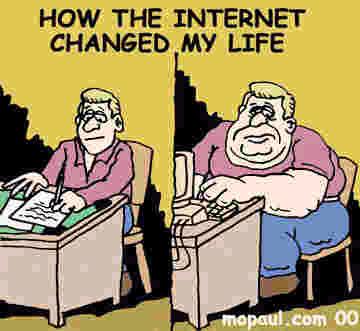
It’s Monday! Do you know who’s watching you? Monday is considered the day of fresh information. Everything is new new new! Consider this: the average 9-5er arrives at his/her desk in the morning (please refer to obese man above), turns on the computer, and tunes into msn.com for the week’s political news, reviews on which movie did best at the weekend box office, and anything else that might be hot off the press. On Monday, people want to know what they’ve missed since Friday (though is probably not much).

Do you take Mondays seriously? Treat your music like a job. Try to have something new on your page each Monday. Whether it be a blog, new shows on your calendar, a quick news update, new photos from the weekend’s show, or new video. The options are limitless and its not like you have to revamp your page every week…just do a little at a time.

Rule of thumb: If you build it, they will come. Read more about this at Drawing Traffic to your Website(s)

Wednesday
In college, my Communications professor told me something I will never forget: most people open their email on Wednesdays. Yes, this has been mentioned on Grassrootsy before, but its worth mentioning again. Wednesday is a unique day. Because it finds itself smack dab in the middle of the week, its the one day that you’re least likely to get “Out of Office” replies. More people at their desk = more people reading their email = more people visiting your website. Optimize on this. Send your newsletter on Wednesday mornings or afternoons if possible. Stop by Email Marketing – Making Sure People Read What You Write for more tips.

Rule of thumb: Send emails on Wed…in the morn or after lunch. Check out Grassrootsy’s additional blogs on Email Marketing here.

Weekends
Stats prove that few erpeople read emails and surf the internet on the weekends, but the people who do are more likely to read through an entire email and will spend more time on your web page than they would on a weekday. For example, if you sent an email on Wednesday, you might get 100 people to open and they would spend an average of 45 second skimming through what you write. But on a Saturday, only 40 people might open up the email but spend a full 3 minutes reading it entirely.

So if you’re posting a blog or sending a weekend email, make sure it’s not time-sensitive. Perhaps you can post musings, and non-essential thoughts. Take it from msn.com: Their weekend news bits are usually reposts of information that that was already used earlier in the week.

Rule of thumb: Never send an email on the weekend that you would send on a Monday or Wednesday.

Friday, June 12, 2009

Fan Interaction

When you’re a band, and you’re putting yourself out there into the public eye (instead of staying locked in the basement), everything you do can be viewed as an interaction with a possible fan. Everything. There’s the obvious – being on stage performing, selling merch, mingling after/pre-show, all really valuable opportunities to give potential fans a meaningful interaction with you, and you’re most likely going to be “on” when you’re in these situations, so you’ll already be able to make those interactions as meaningful as possible.

But what about the less obvious times? What about when you’re just out picking up beer, or gear, or working your day-job? What about when you receive an email from a fan, a facebook message, myspace comment?

Pretty much everything you do could be viewed as an interaction with a potential fan, so it might be interesting to try to think of ways to make all those situations just a little bit special. What if you gave the cashier at the beer store a download card for a free song? Went out of your way to comment back to someone online, or post something on your blog mentioning someone who recently sent you an email about the band, or what if you gave someone who’s buying a CD from you an extra copy for free, so they can give it to someone else?

There are all sorts of ways you can give someone just a bit of something more than what they would expect – all you have to do is find ways to tie those little extras back to your band, and try to genuinely incorporate that behaviour into your daily lifestyle. Suddenly everything you do could become an exercise in making fans, and if you give someone a little bit extra, something more than what they were expecting to get, you’ve increased exponentially the chance they are then going to tell someone else about you too.

Sunday, May 24, 2009

INNOVATIVE ADVERTISING

Oh advertising! Is it really worth it as a musician? Well, it depends. Where are you advertings? What are you advertising? And do you have money? Of course you want to try to get as much free publicity as possible. If you can do it for free, definitely go for that option!

When you do get the funds, check into these ideas. The great thing about the following options is that you can advertise at whatever price is affordable for you.

And in continuation to Monday’s blog, Finding Your Niche, the below suggestions allow you to advertise directly to your niche.

StumbleUpon
Its a great source for people who wanna find good things online. StumbleUpon doesn’t just focus on music. It exposes surfers to every type of website in the world. How does it work? Lets say you wanna get your myspace out to a unique type of listener (See yesterday’s post: Finding Your Niche). Click on StumbleUpon Advertising and create a campaign. As you create your campaign, you’ll see that you can choose what types of people you want to visit your website – everything from people who are history buffs to people who are vegetarian, to people who like kayaking. Tons of random categories.

So what if your music appeals most to men, maybe you’d want to pick people who fall into the following categories: home improvement, mens issues, video games. Or if you think your music has ambience that best fits the spiritual guru/yoga type crowd; you might want to pick people who fall in the following categories: yoga, self improvement, ambient music.

You’re also given the option of choosing age range, geographic location and other demographics. StumbleUpon only costs .05 cents per view. So you could spend $20 on advertising and that would expose your website to 400 people. Check out their short video tutorial.

Facebook (and Myspace)
Its much the same concept as Stumble Upon: i.e. target audiences, demographics and all that jazz. One thing I’ve noticed and like about Facebook ads is that it allows you to pay for impressions by the thousands. So that means, if you set your ad price as 20 cents per 1000 impressions, your ad will show up on the side panel of 1000 facebook pages. Whether 5 people or 500 people click the impression, you still only pay 20 cents per 1000. I’ve found that Facebook isn’t as straighforward as StumbleUpon and takes a little time to understand.

I haven’t tried Myspace advertising, so if you have experience, please comment below.

The Pizza Boy (ya, for real!)
During the week of his CD Release, Pittsburgh artist T. Mitchell Bell stopped into his local pizza store, and asked them if they would be able to distribute flyers for his CD release everytime they had to make a delivery. AWESOME idea! They let him do it for free b/c he was a very regular customer!

Stop into your local restaurant, whether it be a pizza store, or something else. Ask them if they’d be willing to do the same. You might have to pay a little something but its a great idea ( they’ll treat you better if they know you). It’s one of the best ideas I’ve heard lately and I think its probably effective.

Sunday, May 3, 2009

Creating True Blue Fans

Many artist & their bands can sing & play, but, they are amazed (sometimes mad) when the audiences fail to connect with them.  When, in reality, the artist and her band have failed to connect with the audience.

Artist and bands work on perfecting their play list of songs to sound like the studio version or the 'cover' version they hear. They throw in some comments; a few dance moves, differenct uses of the mic, etc.

Isn't that a 'Good Thing'?  To some degree, but when an artist and her band take the stage, their show becomes an experience that must entertain their audiences!  Everthing happening, on stage, is live.  There are no edits to make the show more entertaining.  What an audience sees & hears is what the artist and her band have created for them.  

If I go see a movie and it doesn't entertain, connect, or excite me, then most of the time I actually take short naps.  Do you want to look out, from the stage, and see many with their backs to you or sleeping or walking out the door during your first or second set?  Absolutely not....you want their attention focused on you and your band.

Most artist/bands never think about changing up a song to allow it to 'CONNECT' with their audience. And, if you don't connect and create special moments of memory, then, in most cases you will not have won over new fans & you certainly will not have what every artist should strive to have and that is:  

TRUE BLUE FANS!  Yes, that is a KSE exclusive.  TRUE BLUE FAN (TBF) are WHAT EVERY ARTIST MUST HAVE to sustain longevity as an INDIE touring band.  

TBF will become the most important part of your TEAM.  They will always be your biggest asset.  Without them, you're headed for a short lived career in music.  

TRUE BLUE FANS are fans that will show up for your shows with new fans. They are the ones that will buy tickets, merchandise, and leave tips in your tip jar, call radio stations, campaign daily for you.  They will create and help maintain a buzz about you. 

Most young inexperienced bands and some mature bands can only tour if they can meet expenses. To me there is nothing more boring than watching a talented band that never changes anything in their act except songs.  If you want to develop into a successful touring female artist, you and your band must have an everchanging show that makes audiences want to come out time and time again to feel and experience new memorable moments they feel connect you & them for a lifetime.  I assume all aspiring artist want to perform their music for a lifetime??

Developing into a "live" exciting and passionate entertainer takes time much practice, money, and developing TRUE BLUE FANS!  It's like going from grade, Jr. High, and High School to getting your Bachelors, Masters and your PhD.  After you have completed those degrees, you need continuing updates and training.  

All Roads lead to the STAGE must be incrementally & continually improved by mastering all the baseline stages.  Once this is accomplished, an artist & her band will forever be developing their passion into creative performances which make connecting moments that create lifetime memories that will change audiences into new fans.  These new fans will become lifetime TRUE BLUE FANS, which means SUCCESS,  for you, The Indie Female Touring Artist & Band.

==end

Female Promotion/Marketing On A Budget

1. Read about you (in your ezine, blog and media coverage)
2. Hear your music (and you speak about it)
3. See photos of you
4. See and hear your music in a visual format (videos, audio slide shows)
6. Experience your music live
7. Talk about you
8. Share your music with others
9. Explain something remarkable that you did

In other words, how can you bombard their senses in such a way that your ideal fans won't forget you?

It doesn't take a ton of money to accomplish that. It just takes lots of creativity and action on your part.

Lay our your plan and work it continously...update it as things change...make sure you are unique.

Wednesday, April 8, 2009

Maximize Your Vocals

Sound Bodies....When your body is your instrument, fitness & nutrition should be combined with a well planned set of vocal exercises to keep it in top form.

Singing may well be the most physical demanding way to make music. But, while most serious singers perform vocal exercises to develop range, tone & articulation, they may not realize the benefits of working the entire body. Good general fitness, as well as a well-designed vocal training program, can increase range, improve pitch, & prevent injuries.

The voice is the only instrument that is alive....it has emotion, it has temperature, it has fluid. Because of that, singing is a physical, athletic experience. Voice teachers claim the physical part of a singer's training is 2/3 of their training....which means you have to be strong & flexible.

While you do not need to be training for a triathlon in order to belt out your favorite tunes, good general fitness & nutrition allow your vocals to reach their full potential.

Since singing uses the lungs, any form of aerobic exercise....including walking, jogging, bicycling, swimming, racket-ball, and tennis.....is useful because it can help develop heart and lung strength as well as physical endurance. Exercises like swimming and aerobics use the breath more than you would for other exercises. Swimming has the added benefit of lengthening the muscles. A singer needs muscles to in their longest form & in their most relaxed form.

Relax & Breathe....Yoga is another popular activity for singers: it relaxes & strengthens the muscles, improves balance, & posture & helps focus the mind on the singer's source of power: THE BREATH.

There are many different kinds of yoga, ranging from very low impact to the intense "power yoga" used by athletes. Kunddaline yoga, focuses on the whole body. It has chanting, it has posture, it has movement, stillness, singing, hand positions & more.

Not all exercises are good for singers....heavy weight lifting is not advisable because it forces muscles to compresses & contract. Lifting weights makes for shorter muscles....which is bad for singers. Developing a "six pack" of abs is not advisable either...singers need to strengthen their cores & Pilate's exercised is a better way to achieve that strength. If you tuck in you stomach really hard, you will feel the tightness in your throat. If singers hold their stomachs too tightly....particularly the upper stomach....they can easily develop vocal problems & stomach nodules & things like that. That area has to be open and expanded. The singer has to learn to use the muscles in the middle of the body in an outward position, not in a tucked-in (contracted) position.

Watch Your Posture....Good posture is important because it allows for the freest movement of air & the most relaxed use of singing muscles. Most voice instructors will tell you to keep your chin level, your knees loose & your shoulders & neck relaxed. Abdominal & back muscles should also be relaxed.

Untrained singers ten to jut their chins forward, which leaves the vocal muscles in a precarious position. They are not grounded or anchored to anything. We need the chin to be IN & the chest to be up, so that the muscles of the vocal instrument can function more correctly. It frees the sound & gives a lot more resonance with less effort & less push.

Many teachers use the Alexander Technique, a fitness regimen that focuses on posture, breathing, balance & coordination. Like yoga, the Alexander Technique involves relaxation to combat tension that causes us to haunch our shoulders, stiffen our necks, & to slouch. Tension in the jaw & tongue can cause singers to go flat, while pelvic & lower body tension can cause them to go sharp because they're "holding & gripping & pushing air." Some singers feel that tightening the muscles gives them power, but, it actually reduces control.

Break Down To The Basics....Some singers need to go back to the basics...take a step back in order to move forward. If you learn the proper use & alignment of the muscles through vocal exercises, your range will grow. If you're not using your muscles correctly, you might have the note in you, but you can't get it out because you're too tight. When you learn how to let the larynx move & tilt the way it is supposed to, you'll hit the notes with no problem.

Like a baseball pitcher has to take care of his arm, a singer has to take care of their voice. Also, like pitching, if you just rely on natural ability, you can get away with it for a while, but you'll never get to be as good as you can be & your risk of getting injured is much higher. If you get a little training, just like a little athletic coaching, you can do better than you every thought you would....& you can do it safer & longer.

Proper training helps prevent injury, too. Learn how to use the chest, abdomen & back muscles to create power, as well as the tissues of the throat, the larynx & muscles efficiently, thereby creating a unique & beautiful voice that carries. If any one of those parts fails to do its job, then singers struggle to compensate....people use delicate muscles in the neck, not designed for power function, & then tissues break down, they get injuries, & they end having to lay off work or even worse have surgery to correct the damage.


Practice Time

How long you practice depends on your level of training & experience. For a complete beginner, go for no more than 20 minutes / day at first & that amount should be gradually increased over a period of months. Never sing if you are ill or suffering with a sore throat or are sounding hoarse. When your voice is healed, start slowly to make sure you don't hurt your voice again.


Warm Up

Like any other muscles in the body, the vocal cords need to be warmed up with excises before asking them to perform. Teachers use different scales, anywhere from 2-note to 5-note scales up & down.

What do those exercises attempt to achieve? There are many muscles....but not all of them are supposed to be involved in singing. It's like playing pick-up sticks: You have to get just the correct muscles involved & eliminate the other ones.


Eat Well to Sing Well

Eat a light meal 2-3 hours before you start your practice or your performance. And drink plenty of water!!! Most vocal coaches recommend somewhere in the range of 8 glasses/day. Avoid caffeine, alcohol or acidic drinks like orange juice before you sing because they can dry out the throat or cause excess phlegm.

Tuesday, March 24, 2009

Music Yesterday & Today

Having a successful music career is not that much different than it has been all along.

Yes we have new tools for DIY folks & you don't need to have a label deal as much as you once did.

"All roads lead to the stage, where you make connections with your music that creates special moments for your audiences".

For the indie artist to be successful, you have to have TRUE BLUE FANS that will support you & your music year in and year out. So TBF are the number 1 priority as far as we are concern. Without them, how will your survive??

well, maybe some have an unlimited supply of money in their bank account??

Monday, March 23, 2009

Press Releases

You know how important a press release is to get the word out about whatever your band or label has going on, be it a new album, a tour, or some other piece of news. But sending that press release a the right time is another key piece of the puzzle to getting media coverage. How do you get the timing right?

As you might imagine, the answer to this question depends very much on the media you are contacting. Radio has a different lead time than a national print magazine which has different timing requirements from a website, and so on and so forth. There are ways you can take some of the guess work out of the equation, however. Do a little research and create a database:

* Contact all of the music media outlets to which you hope to promote your music, and ask them about their deadlines. Start a database on your computer tracking this information, so you always have it on hand. You should do this far enough in advance that you haven't missed deadlines by the time you get around to making your calls. For instance, if you know that you will be releasing an album in 6 months, make those calls now.
* Contact any freelance writers you know and ask them how far in advance they need news from you to be able to run with it. Add this information to your database as well.
* Your database will probably primarily include national outlets, plus local outlets in your area. However, don't forget to contact local outlets in towns that the band plays often, or if you have a tour planned, local papers/magazine/radio in the towns on the tour. You might not be able to plan for these contacts as far in advance as you might like, but do it as soon as the shows are booked.

Beyond taking these steps, there are some general guidelines to keep in mind:

* For a new album or single, sending out press releases and promos 2 - 3 months in advance is ideal (national publications have very long lead times - smaller mags, local papers and websites may have shorter lead times, but it is better to be early than late!).
* For a tour, 6 weeks or so ideal, though 4 weeks can sometimes be ok. How early you send your press release for a tour depends on the kind of coverage you are trying to secure. If you just want to get in the show listings, then you can afford to cut it a little closer (though many national magazines will have specific deadlines for show listings pages that you need to follow). If you're hoping to get a piece written about the show or the band, earlier is better.

If this all sounds a little confusing, don't fret. Press release timing is an art, not a science. The best thing you can do is gather all of the information about deadlines that you can and stick to those guidelines as much as possible. Follow up after you send a press release, especially as your release date/show date nears to make sure you release has not gotten lost in the shuffle and to encourage them to give you some coverage. Last but not least, you should never skip the press release because you think it is too late. You never know what can be pulled off at the last minute, plus, even if it IS too late, you're still getting your name out there, which can only help you next time you send out a press release.